
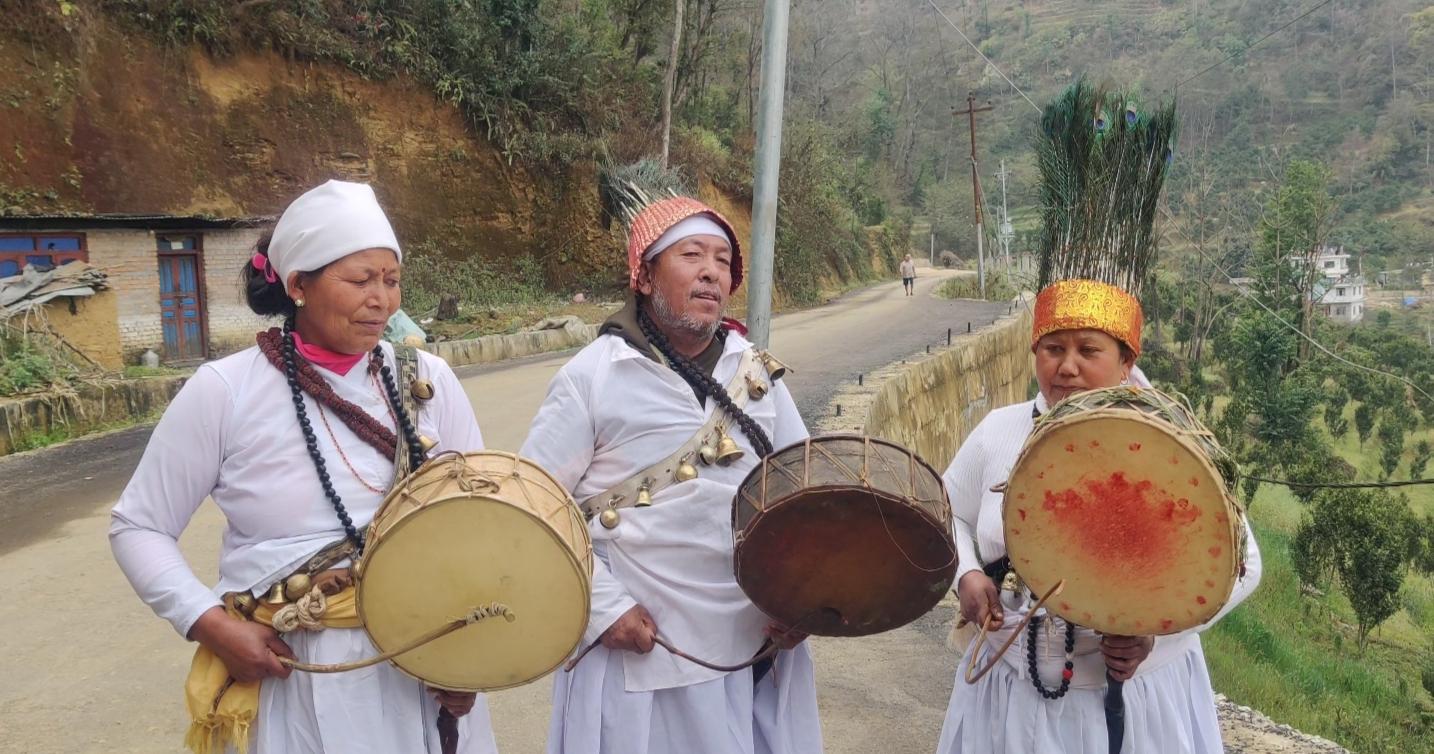
Most travelers come to Nepal knowing something about Hinduism and Buddhism. They see temples in Kathmandu, prayer flags in the mountains, monasteries along trekking routes and shrines almost everywhere.
But there is another spiritual world in Nepal that is much easier to miss.
Shamanic traditions are still part of life in many communities. They involve ancestors, spirits, healing, nature and the effort to maintain harmony between the human and spiritual worlds.
The important thing to understand is that there is no single form of “Nepali shamanism.”
Travel from one community to another and the name of the practitioner can change. So can the chants, rituals, stories, sacred objects and beliefs behind them.
For a traveler, knowing this difference is the beginning of understanding what you are actually seeing.
There is no single Nepali shaman
The word shaman is convenient when explaining these traditions in English. In Nepal, local names tell a much richer story.
Among Rai communities, traditional ritual specialists may be known as Bijuwa or Nakchhong. Their roles can include communicating with ancestors and spirits, conducting rituals and responding to illness or misfortune.
Among the Limbu, or Yakthung, several ritual specialists are associated with the Mundhum, the community’s sacred oral tradition. These include the Phedangma, Samba, Yeba and Yema.
In Tamang communities, the Bombo is an important traditional shamanic practitioner. Tamang spiritual life has also developed alongside Tibetan Buddhist influence, so traditions that outsiders may try to separate neatly can exist together.
The Thami, Magar and Gurung communities have their own ritual specialists and traditions. Dhami, Jhankri and Guru traditions are also found in different forms among other communities across Nepal.
Remembering every title is not necessary.
What matters is recognizing that when someone says, “I want to experience shamanism in Nepal,” the next question should be:
Whose tradition?
What are these rituals about?
It is easy to focus first on what can be seen and heard.
A drum may be beaten repeatedly. A practitioner may chant or recite words that a visitor does not understand. There may be offerings, incense, movement or long periods of intense concentration.
Those are the visible parts.
The meaning behind them can be much deeper.
Different traditions have different explanations, but common themes include relationships with ancestors, communication with spirits, local deities, illness and healing, protection, and respect for forces connected with the natural world.
A mountain, forest, river or particular place may therefore be more than scenery. It can belong to a spiritual landscape as well as a physical one.
This is one reason shamanic traditions are especially interesting in Nepal. They can reveal a way of understanding the same landscape a traveler has been walking through all day.
Seeing a ritual is not the same as understanding it
This is where many visitors miss the most interesting part.
Imagine entering a room and hearing a drum, seeing offerings and watching a ritual specialist chant for an hour. It may be fascinating.
But without context, what have you understood?
You may not know why the ceremony is taking place. You may not know who or what is being invoked. You may not understand the significance of an object in the room, why certain words are repeated, or why one ritual looks completely different from another you saw elsewhere in Nepal.
The explanation around the ritual can therefore be as valuable as the ritual itself.
This is also where local knowledge matters. A good cultural experience should not simply bring a traveler close enough to watch. It should help the traveler understand who is doing what, why it matters, and how the practice fits into that particular community.
That turns something unfamiliar from a spectacle into a cultural encounter.
Shamanism also shows another side of Nepal
Nepal is often presented to travelers through its most visible identities: Everest, trekking, Hindu temples, Buddhist monasteries and Himalayan scenery.
All of these are real parts of the country. But they are not the whole story.
Shamanic traditions provide a window into older and highly local ways of understanding health, misfortune, ancestors, nature and the unseen world. They also show how spiritual traditions in Nepal do not always fit into the simple religious categories visitors arrive with.
A person may participate in Buddhist or Hindu life while also respecting practices that outsiders would describe as shamanic. Traditions can overlap, adapt and continue alongside one another.
Once you understand that, Nepal starts to look different.
A village is no longer only a place to sleep during a journey. A forest is not necessarily just forest. A household ritual is not simply something strange happening behind a doorway.
There are layers of meaning that are easy to walk past when nobody explains them.
Come curious, not looking for the exotic
You do not have to share a community’s beliefs to find its traditions meaningful.
You only need enough curiosity to ask better questions.
Who is this practitioner? How did this tradition come to this community? What does the drum mean? Why are ancestors important? What is believed to be happening during the ritual? How has the practice changed as Nepal itself has changed?
Those questions lead much further than simply asking, “Is this authentic?”
Shamanism in Nepal is not one preserved relic from the past. It is a collection of living traditions, different from community to community and still meaningful to people who practice and respect them.